Farveblind
Denmark

Farveblind
Denmark
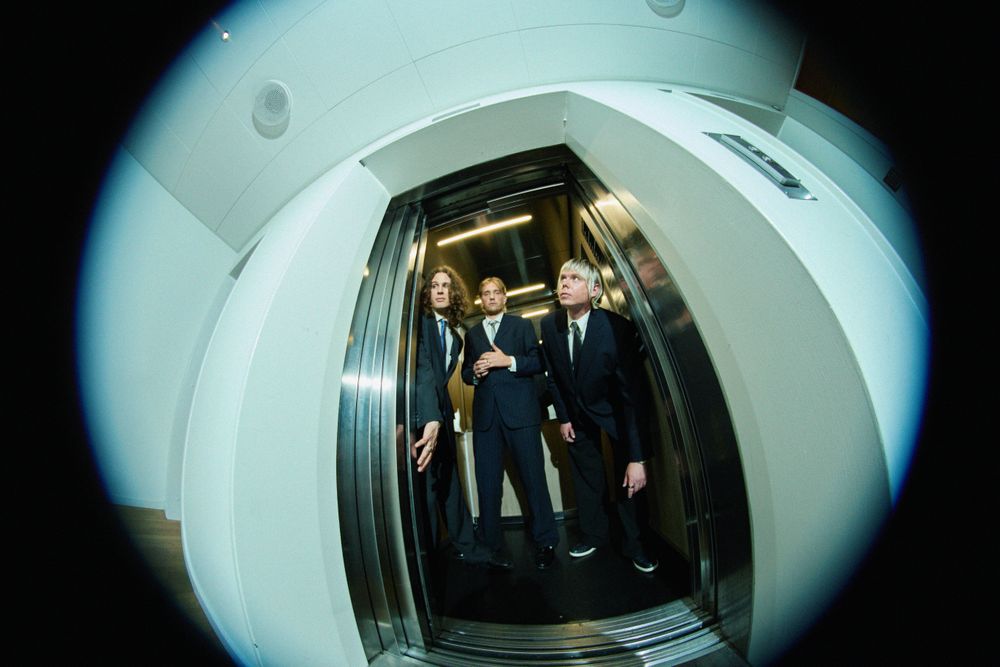
For Copenhagen trio Farveblind, the initial mission was to just make stuff happen. Conjuring an intoxicating blend of techno, breakbeat, industrial and post-punk, initially, there wasn’t a well-devised plan on how to make stuff happen. The trio of Jens Asger Lykkeboe Mouritzen, Magnus Pilgaard Grønnebæk and Anders Norre Arendt prided itself in being an unguided projectile of the party starting-variety – a mindset that garnered them unexpected acclaim as a firebrand live act, performing festivals like Roskilde, Eurosonic and Reeperbahn. “I think the original plan was: we saw a lot of concerts, and we were like, we want to do some sort of art where we break down the barriers between what it’s like being on stage and being in the audience,” says Magnus. “So we really wanted to do a thing where we kind of messed with that whole dynamic. And back then we didn’t really care too much about what the music was. At that point, we weren’t that good, we weren’t really producers yet. We just listened to a lot of electronic music, mainly, and we came from playing in different bands.” Farveblind initially started as the duo of Jens and Magnus, with Anders joined a few years later. That’s when they began honing their kinetic, punk-oriented approach to electronic music: as a trio, the songwriting became tighter, the arrangements became more adventurous, their grasp of texture and melody expanded into novel, exciting avenues. As it was for many artists, the Corona-pandemic became a vital period for Farveblind to revise and fine tune what made their inner dynamics beloved on stage in the first place. “Something very interesting happened when the three of us tried to compose and write music, instead of just thinking, how do we do a drop for live shows? How do we make a song that’s worth listening to?,” says Jens. “What’s important to mention is that the whole process of actually creating music, and not just the tools for dancing, started in 2020, with the three of us basically isolated in a studio.” The EPs Mayhem (2021) and All Clubs Are Bastards (2022) are recursory to the direction of their long-awaited debut album. In broader strokes, Micro Pleasures – out May 15th 2026 – finds Farveblind having a lot of fun with an eclectic array of artist peers with whom the trio crossed paths with throughout the years. But these 11 tracks also express where such abandon can be cultivated in a society where dread, apathy and chaos are rife. "'Micro Pleasures' is an ode to the small glimpses of happiness you find in the otherwise oppressive mundanity of modern life,” the band said in a joint statement, shedding light on the overarching idea behind the record. “It explores how fleeting everyday joys can act as both coping mechanisms and subtle forms of resistance. The album is a collage of work with a lot of very exciting people. It allowed us to tap into genres and energies that wouldn't have been otherwise unavailable to us." Through the prism of artists of all styles, walks of life and cultural backgrounds, Farveblind reinforces its virgin ideals of a communal, decentralised project: by casting such a wide net of contributors, Micro Pleasures – Produced by Farveblind and mixed by Gustav Brunn (Viagra Boys, Yung Lean) – organically captures the tumultuous times we’re living through. The impressive tally of guest appearances on the album includes itcallsme I, Sean Michael Seldorf Flaherty (USERS), k.flay, Elliphant, Jesse Clasen (Foreign Air), Sebastian Monti, Jesse Markin, Emmeline, and Django Django.
“We really want to collaborate with artists, not just singers,” says Magnus. “Because that forces the three of us to be creative in new directions, and it keeps the train running. I also think we’ve created a sandbox for other artists to dig into, where they can maybe step a bit outside of what they’d do if they were going to release music themselves.” Lead single “Salary Man”, with incendiary vocals by USERS’ Sean Michael Seldorf Flaherty, is an acerbic techno-house exposition on prosaic office culture, while, the suspense-driven “Battle Lady-Like”, featuring Foreign Air’s Jesse Clasen, channels Dave Arnold and early Soulwax, feeling like a white-knuckled chase scene of a futuristic spy movie. Third single “Natural Behaviour” appoints UK artist Emmeline as its lead vocalist, showing a more atmospheric, introspective side to the Farveblind-vernacular. “I started thinking about someone waiting for someone’s natural behaviour to shift,” Emmeline said of the latter track. “And how that can be a pretty futile task. Maybe the song exists in a club at the ends of the earth, where we’re all questioning why the grass grows upwards, why the bassline hits harder when the beat drops, why we punish the earth for what it gives us — and how some patterns are hard to break.” k.flay effortlessly cool, deadpan delivery on bass-driven electro-punk drill “Things” highlights similarly conflicting sentiments within the allure of consumerism: ‘Use it, lose it, find it buy it/Then repeat the process/Funny how the price tag isn’t really what the cost is’. “Do You” meanwhile, lifts Farveblind’s typically monochromic atmospherics to a more Balearic beachside scenery, powered by Elliphant’s sultry vocal delivery: fruits that bore from a particularly chaotic, late night studio session. Finnish MC Jesse Markin cuts through the big beat “Parapraxis” with his incisive flow and itscallsme i’ adds cheeky bravado to the dance- punk of album opener “Knock Down Your Door”. Whether it's reconstructing productions from the ground up, working within set limitations, or homing in on that sweet rave nostalgia, Farveblind leans fully into the tides of what each collaboration brought to the fore – relishing as much in the process as the end results. For all three members, ironically, Micro Pleasures also meant an end to micro managing the work and guiding the music to its natural outcome. “It just came to a point—and this happened with a lot of tracks, and also with future Farveblind tracks—where you realize that even though you’re engaged to something, you’re not necessarily married to it,” Jens reflects. “I really learned through this process that you need to let go to see where the track wants to go, and not where your nitty-gritty, hyper- focused self wants it to go.” In their formative phase, Farveblind might have opted to close an album by going nuclear - like on the noise-laden instrumental “Heartbreak Beats”. But funnily enough, for a band named after the Danish term for ‘colorblind’, ending with the more colorful horizon-peering “All of the Atoms” – a collaboration with UK art rockers Django Django – offers reprieve from the beat-driven skirmishes Farveblind have mastered. “‘All of the Atoms’ has a very, very special place in my heart,” says Magnus. “Because there’s time in that track. It feels like there’s nothing we need to do. It feels like there’s some kind of calmness to nothing happening, in a way. So it’s building, but it’s not building toward anything. And I feel like ending on that note— to me, it just makes me want to listen to the full record once again, because it doesn’t necessarily have to end on a high. I feel like this is one of the first times we’ve collectively worked against what we’ve always learned—like, that we need to end up here. And I just think it’s so beautiful that with this record, we end in the complete opposite direction. And I’m really, really proud of that.” Micro Pleasures, for all its modest outset in ‘making music with friends and sharing good vibes’, naturally spawned music that’s political and pleasure-seeking in equal measure – and apologising for neither. “This late-stage capitalism world we live in feels like a hamster wheel,” Anders concludes. “No one is exempt from that hamster wheel, and so everyone sort of tends to write music toward that. For example, when we were recording “Knocking Down Your Door”, we were standing outside while we were having a session with André (Stärnman) and Camilla (Wallöe Ayangco), and André was just like, ‘Oh, I’ve quit smoking, but I want this little one thing. It’s not an addiction; it’s just a little pleasure. It’s a micro pleasure.’ And that stuck with all of us. We were like, ‘You’re completely right about this’. And from that point, we stitched together this overarching narrative of that being a common theme, and it just worked out naturally with the whole record.”